Refit and customise your boat electronics: navigation, instruments, audio and sonar with native Android displays and shared Pi services. Refitting Number Five has created a building kit we can use, change, extend and share.
Developed with AI. Built on open foundations. With room for your ideas.
NO. 05 / MAPNATIVE ON THE LUMINA
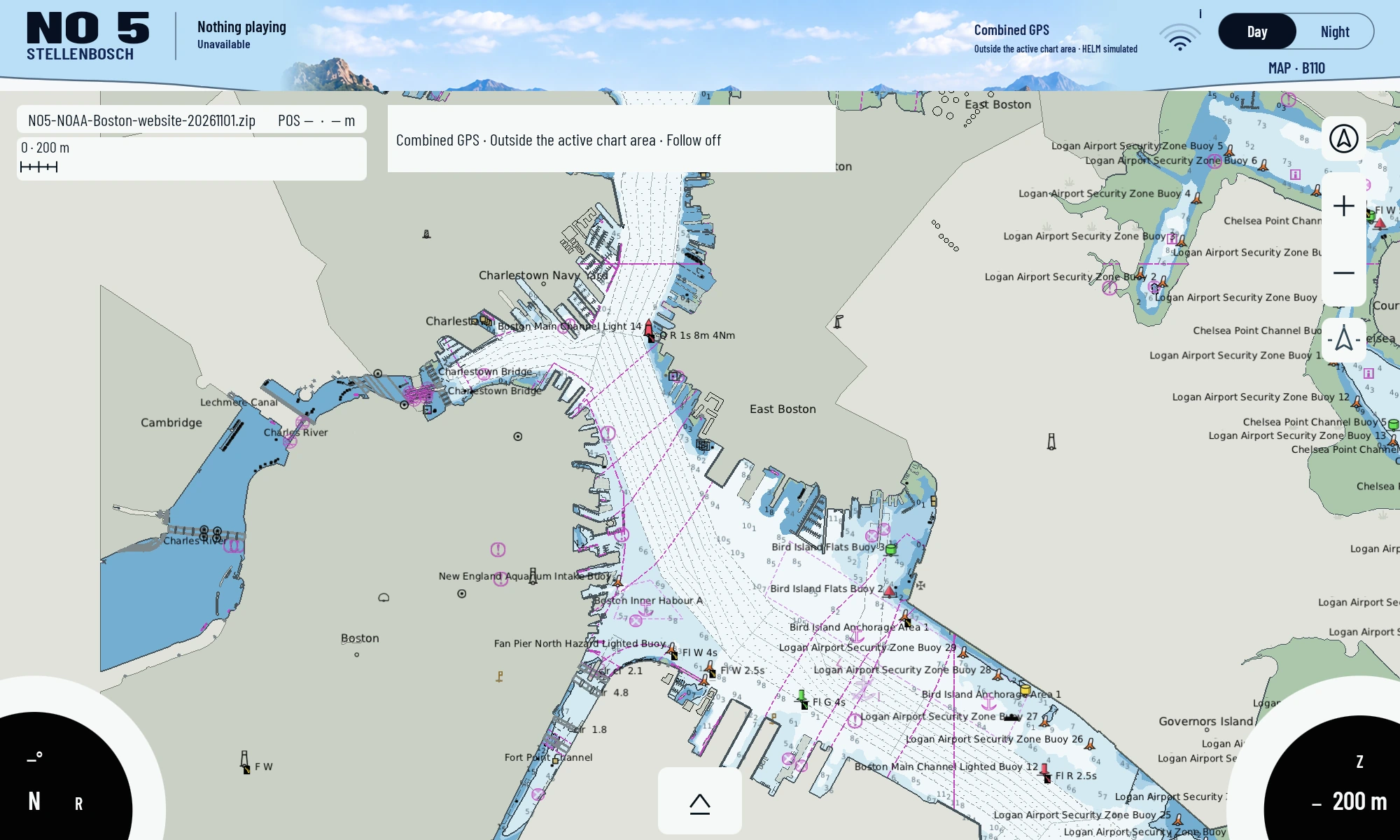
Current device capture on 1 November: NOAA Boston charts rendered locally on the Lumina. The chart dataset was accessed on 3 October; position outside the chart area, other header data simulated or unavailable.MAP110 ·0.5.42-memory-budget-v8 · Lumina K706 · Android10 ·2000×1200
Choose the hardware. For your budget and installation.
Shape the controls. Local and native on Android.
Extend the system. Through shared interfaces.
01 / WHAT THE IDEA LOOKS LIKE
Three applications. One connected idea.
The benefit lives between the apps: the display can change while the service remains. We control the design and describe the data paths. These examples show existing work and its next steps.
MAP / LOCAL RENDERING
The chart becomes part of your interface.
Native chart rendering, our own route and layer controls, an inexpensive display. The device GPU draws locally. HTTP and WebSocket connect shared services. This opens up design choices a price comparison alone cannot describe.
Detailed view after a native zoom step in MAP 110. NOAA S57 Boston dataset; current app capture, not a current nautical chart service or a speed measurement.MAP110 ·0.5.42-memory-budget-v8 · Lumina K706 · Android10 ·2000×1200
AUDIO / SHARED CONTROLS
One sound system. More than one control position.
Music playback and sound processing run in the independent Pi module. The native interface controls the service: volume, sound and outputs belong together. Another client can build on that foundation instead of creating a second playback system.
Current room view of the active preset: rounded 34% effect amount and 57% room size. Reflection lines are explicitly schematic; not an acoustic measurement.HELM 206 · 0.8.134-sonar-start-depth-controls · Lumina K706 · Android 10 · 2000 × 1200
SONAR / MAKING SIGNALS USEFUL
Echoes belong on your display.
An examined Venterior fishfinder, a Pico and our own processing: real echoes become visible in the Android interface and depth can be shared with other services. The specific test setup is documented; trials aboard are still ahead.
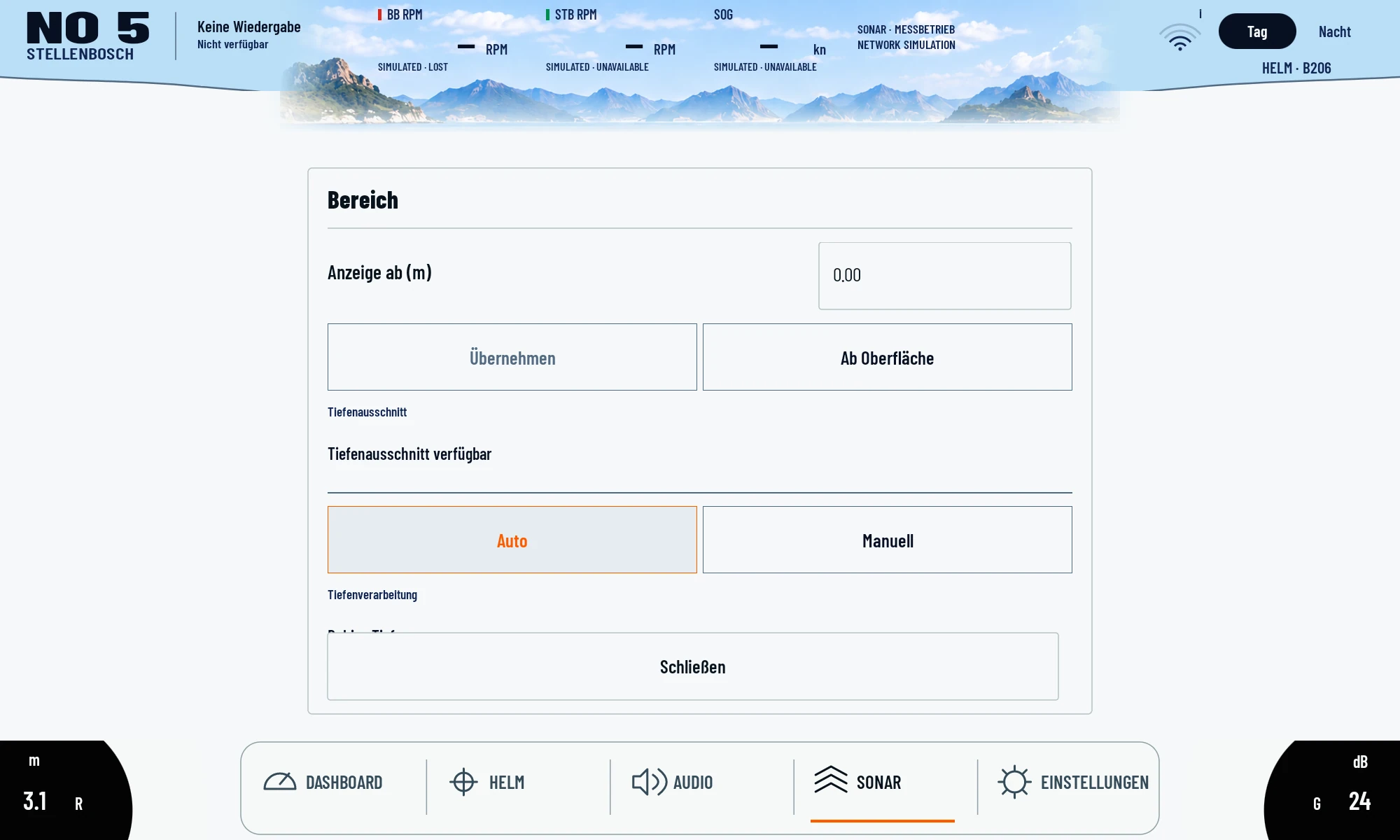
Current native range dialog with existing automatic mode and start depth. No acquisition or filter settings were changed.HELM 206 · 0.8.134-sonar-start-depth-controls · Lumina K706 · Android 10 · 2000 × 1200
SEE FOR YOURSELF
On the actual device.
Clips play only on request and run at original speed. A screen recording shows controls and data flow; it is not a separate performance measurement.
NATIVE DEVICE CAPTURE45 s · 1×
The current chart on the affordable display.
Almost 45 seconds from the installed native MAP 110 app: pan Boston Harbour, zoom in and out, rotate 45 degrees, return north up and briefly open the Layers workspace. Uncut original speed, without music.
Four existing NOAA Boston cells as a rendering example. Dataset revision and capture time are documented separately. Touch input was automated through ADB, including a stepwise two-finger rotation whose automated input takes about 19 seconds here. Recording rate and input sequence do not measure app frame rate, GPU time or display latency. A separate object query returned NO_CONFIRMED_PORTRAYAL.
32 seconds of native recording on receiving client Lumina 1: the main fader is moved from −39 to −40 dB and restored on Lumina 2. Both devices, the gateway and Pi DSP show the same state.
Confirms the shared main-fader state in this setup; no claim of frame-accurate synchronization or measured latency. No montage, music playback or acoustic measurement. Other boat values remain labelled as simulated.
2026-11-01 · Receiving Lumina 1 K706 · Android10 · 2000 × 1200 (recording1280 × 768); controller Lumina2 K706 · HELM 206 · 0.8.134-sonar-start-depth-controls on both devices · Original speed, silent
Text description and context
32 seconds of native recording on receiving client Lumina 1: the main fader is moved from −39 to −40 dB and restored on Lumina 2. Both devices, the gateway and Pi DSP show the same state.
Confirms the shared main-fader state in this setup; no claim of frame-accurate synchronization or measured latency. No montage, music playback or acoustic measurement. Other boat values remain labelled as simulated.
31 seconds from the current native HELM app: existing sound presets, EQ, room view and speaker positions. Real Pi sound settings were independently checked against the running DSP.
No playback source connected; no music, artificial spectra or changed sound settings. The boat header is labelled as simulated. This shows operation on one client; the separate two-client clip demonstrates shared control.
32 seconds from the native HELM app on a physical Lumina: the live echogram and A-scope on the existing test setup. The A-scope view is hidden and shown again.
Test setup with our own echo acquisition and displayed depth. Temperature is not shown. Other header telemetry is labelled as simulated. Recording frame rate is not an app or GPU measurement.
An uncut sequence on the physical Lumina: appearance, schematic style preview, chart content and the existing chart library. Every screen comes from the installed native MAP app.
Supplementary UI tour; not proof of chart panning, zooming, rotation or rendering speed. The schematic style preview is not a rendered nautical chart. No settings were applied.
Chart images are captured in MAP 110 with the existing NOAA Boston test package. Audio shows real sound data from the running Pi service; track/playback state for the library and queue was missing during capture. Simulated boat values in the header are identified separately.
02 / WHY IT BELONGS TOGETHER
The display presents. The service connects.
Sensors and devices supply data. Services handle their specific tasks. Today’s Android interface renders locally and accesses them over the boat network. A display can look different without losing the shared foundation.
A new control position, another sensor, an additional application: each needs suitable integration, without requiring a completely new system each time.
Our examined Luminas cost €75 per display according to my own report. Another device needs a suitable profile and a test. The idea remains: controls and services work together while hardware can be chosen.
A control position where you need it.
Helm, second seat or a dedicated control: shared services give the extension somewhere to connect. A wireless button still needs a specific radio link, power and acknowledgement mechanism.
A design for your taste.
Day, night, instruments, music and charts can share a control environment of our choosing. iOS would be another client requiring development; today’s main interfaces are native Android apps.
04 / THE PATH WAS NOT STRAIGHT
Every solution revealed the next problem.
Android 14 turned out to be Android 10. Charts did not simply fit into memory. An attractive control was not yet smooth to use. And a finished design was far from an installation. Those detours created the shared foundation.
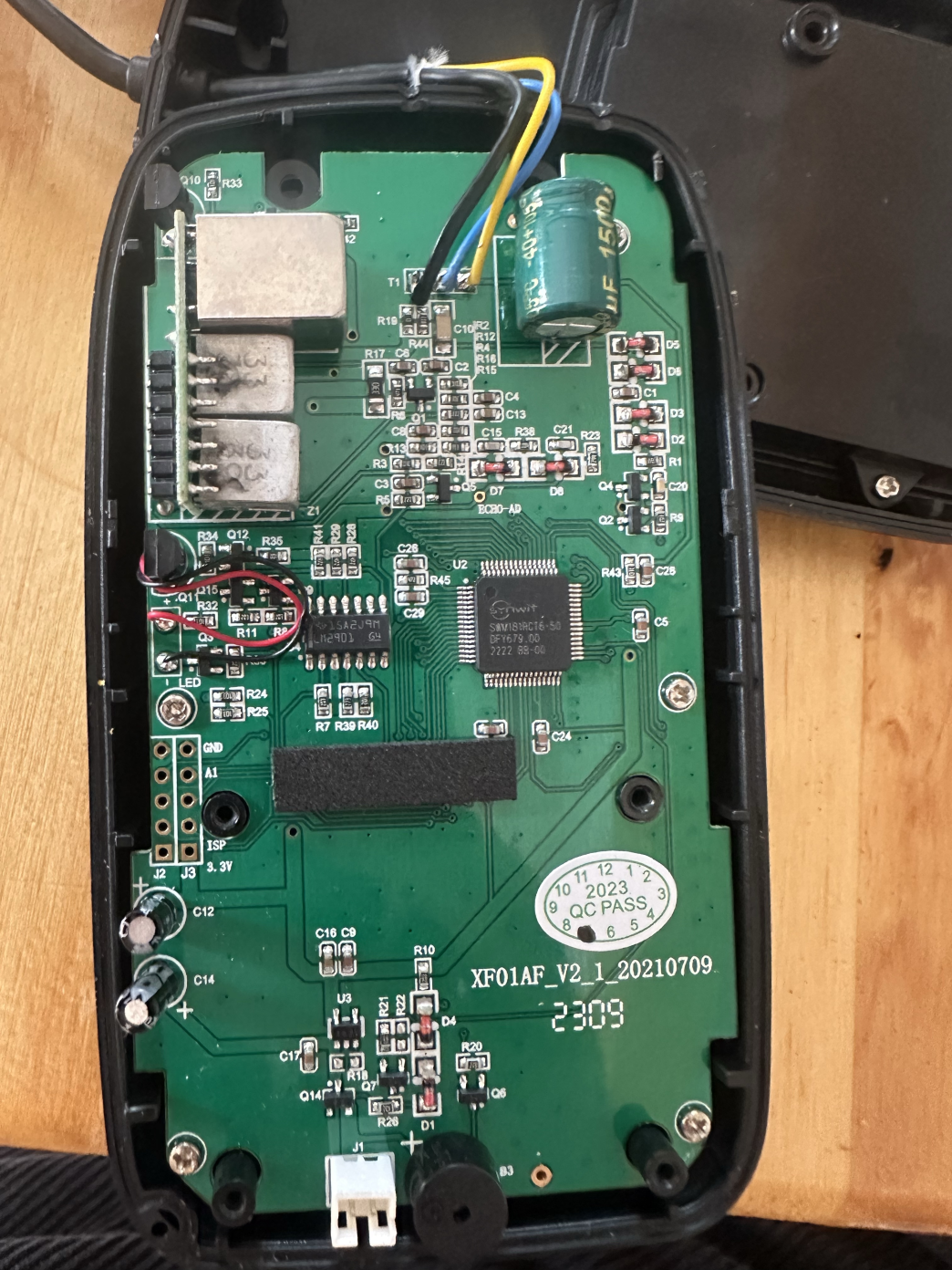
The actual board of the Venterior fishfinder under investigation. Existing photograph crop from hardware exploration in October 2026.
From a closed device to our own signal path.
The workshop story connects the decisions: what we wanted, what failed, what we changed and what became useful. Software, hardware and installation developed in parallel.
The display is inexpensive. The system deserves an honest breakdown.
A €75 display makes getting started interesting. An installed boat system includes more. We show its components rather than counting unknown costs as zero. Updated: 1 November 2026.
Cost components of the Number Five setup
Component
What it includes
Evidenced price status
Display
One Lumina/K706; €75 according to my own purchase report. Count a second device separately.
€75 · owner report
Pi and storage
Raspberry Pi 5, 8 GB; cooling enclosure and 64 GB microSD are documented in the inventory.
Purchase prices not recorded
Power
DC converters, fuses, wiring and power for the chosen devices.
Setup-dependent · open
Audio
USB 5.1 sound card documented; amplifier, speakers and acoustic setup depend on the boat.
No evidenced package price
Sonar and sensors
Examined fishfinder, Pico, adapters and sensors for the chosen configuration.
Purchase prices not recorded
Enclosures and fabrication
Count print material, screws, boards, connectors, printing and soldering separately.
Material + fabrication open
Installation and shipping
Installation, cable routing, local sourcing, shipping and possible import costs.
Country- and boat-dependent
Inventory records confirm core components but contain no reliable purchase-price fields for them. Labour, shipping and imports remain open. We therefore give neither a misleading total nor a blanket comparison with a finished plotter.
Sourcing in South Africa: specific historical examples
Recorded inventory includes a four-way RCA connector at R24.38, a fuse holder at R18.57 and an HW64 converter at R72.10, each excluding VAT. These historical individual values were checked on 1 November; that does not confirm purchase date, current availability or shipping. They do not automatically all belong in the same variant.
Venterior V15-2 print preparation estimates around 338 g of PETG including supports and a test piece. This is a slicer estimate, not measured consumption or a fabrication price. Alternatives must match function, dimensions and connections. Local suppliers and assembled modules are particularly useful contributions.
Why build an alternative? Do I have to solder? And what has actually been tested? We take up feedback and explain what we do with it. The comic crew gets to ask; we have to answer.
Code, circuits, designs and experience are here to build on. Help test, find local parts, print a better mount or offer installation and fabrication. A useful workshop contribution matters as much as a new app.